(Note: This post is a continuation of our series on highlighting the Climate Adaptation, Resiliency and Empowerment Program (CARE). Follow along as we share more about student experiences.)
Students play a vital role in shaping the future of food systems by connecting research, policy, and practical experience. We’re excited to highlight one such student, Chloe Zinn, a CARE Program student, who recently attended the 2025 Canadian Science Policy Conference (CSPC) in Ottawa.
Thanks to support from the University of Guelph’s Office of Research, Chloe was able to represent our team and immerse herself in the sessions. As a master’s student in Food Systems & Sustainable Transformations, focused on policy, this was an excellent opportunity to bridge the gap between classroom learning and real-world application.
Read about Chloe’s experience attending CSPC and engaging in conversations at the intersection of science and policy in her own words below.
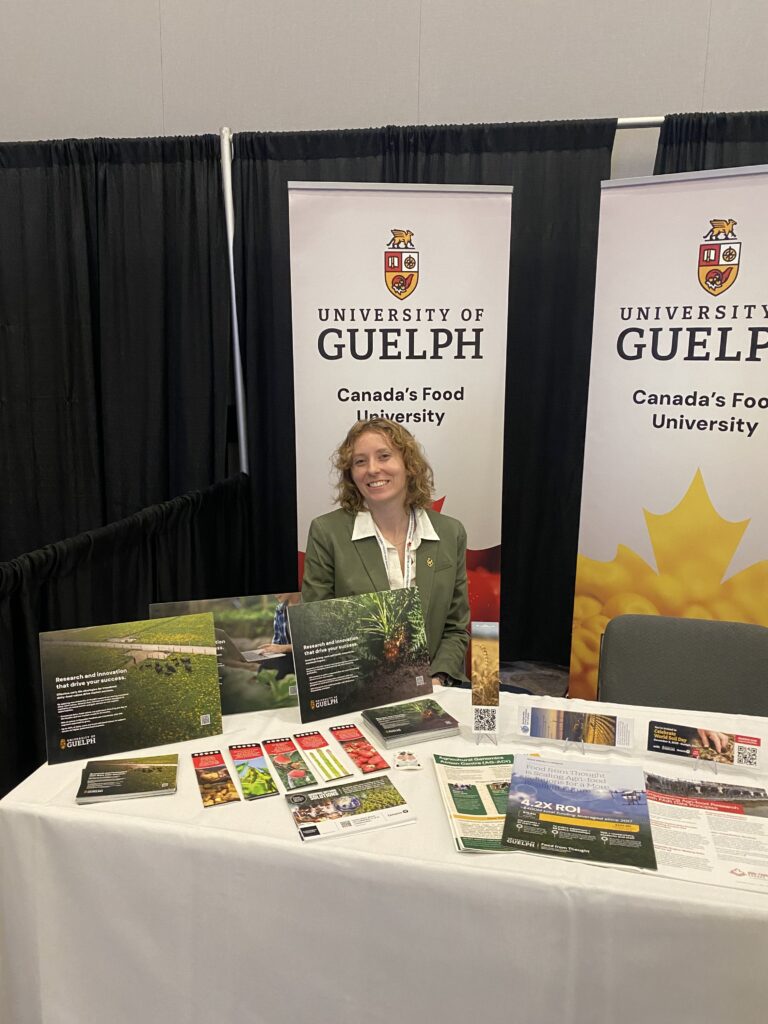
“Last month, I had the unique opportunity to support the Research and Innovation team and represent the University of Guelph at the 2025 Canadian Science and Policy Conference in Ottawa. The theme of this year’s conference, Towards a Resilient Future for Canada: Mobilizing Science, Knowledge, and Innovation, set the stage for a series of insightful discussions.
Throughout the event, I attended plenary sessions and panels addressing some of the most pressing issues that Canadians are facing today, including challenges in science communication and diplomacy, questions of policy and governance, and the implications of artificial intelligence on the future of research and industry. I was particularly drawn to the conversations surrounding the ethics of AI use, especially as my experience as a teaching assistant has shown me how widely these tools are being adopted in academic settings.
Two sessions that stood out to me featured University of Guelph faculty members discussing how to bridge economic, social, and environmental visions for a positive food future, which are topics that directly relate to my own research on food loss and waste governance.
While hearing from thought leaders and policymakers was insightful and impactful, some of the most inspiring conversations I had were with other attendees from across Canada, many of whom have been grappling with the challenges of the science-policy confluence in real time.
During my free time, I also took the opportunity to explore Ottawa, visiting Parliament Hill and the Senate, an experience that rounded out an already memorable week of learning and connection.
I left the conference with so much new knowledge and insight into not only the importance of scientific research communications and translation in current Canadian contexts, but also many new skills and relationships that I will take with me into the future.
I would like to extend a huge thank you to the Arrell Food Institute and the Research and Innovations team for the invitation, for encouraging young academics to engage in innovative, cross-sectoral spaces, and for creating such a welcoming environment for curiosity and conversation.
List of the sessions I attended:
- Canada at a Crossroads: Science, Technology, and Innovation in a Changing World
- Bridging Trust and Accountability: Legal, Ethical, and Community Perspectives on Post-Deployment AI Governance
- Canada’s Agri-Food Mission for Economic Prosperity and Global Food Security
- A National Agri-Food Research Strategy: Empowering Cross-Sectoral Partnerships for Greater Impact
- Inclusive innovation: how about co-creating science policies?
- From Survival to Resilience: Rethinking Burnout Through Economic and Policy Reform
- Empowering Female and Non-binary Researchers: 9 Years of Soapbox Science in Canada
- Same is Not Fair: The Impact of How We Think About Fairness on Our Perceptions of Scientists with Disabilities in Canada”
To learn more about the CARE program, visit: https://www.care-climate.com/about-care/