Linking global data with local context is crucial as the world responds to compounding crises
The global food system is built on three assumptions: cheap fuel, easy trade and a productive physical climate. Right now, all three of those assumptions are eroding.
New tools and mechanisms are needed to help the most vulnerable, where they need it, when they need it. That was the theme for “Acting at the Speed of Crisis”, a Climate Week NYC event hosted by FoodTank, AFI and RAAPID, with support from the Rockefeller Foundation.
Here are some highlighted quotes from the event. You can also watch the full livestream recording on Food Tank’s YouTube channel.
Evan Fraser, Executive Director, AFI:
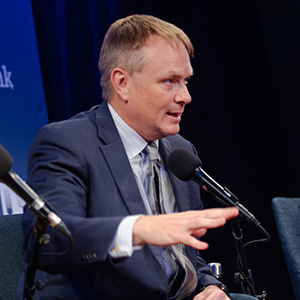
“We need data to anticipate where the problems are going to land, so that the policy makers can proactively anticipate where crises are emerging and get in there faster.”
“I think there’s a moment here for middle powers in the food space. Food is being weaponized … but it could be used as a stabilizer. It could be used as a coordinator, as a galvanizing force for good.”
Inbal Becker-Reshef, Managing Director, Microsoft AI for Good Lab; Founder and Co-Director, NASA Harvest; and Founder, RAAPID:
“We’ve seen food be weaponized. We have to be thinking not only about how do we have the information for this season, for local realities, but also where we’re sourcing from and exporting to, and we have the long view of our climate systems.”
“We’ve seen so often our early warning systems fail. How do we make sure we’re moving into action, and providing the data that is needed when it is needed?”
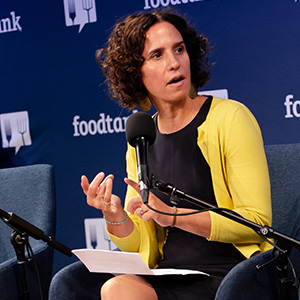
Simon Winter, Vice President for Reimagining Humanitarian Nutrition Security, Rockefeller Foundation Catalytic Capital:
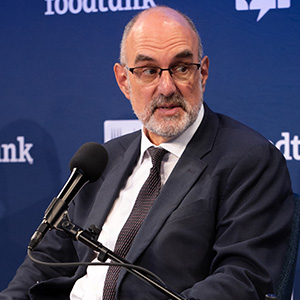
“We need this info to guide resilience investing … because the risk of harvest failure is going from every 20 years to every 10 years to every 3 years. … Anticipating shocks as part of resilience financing.”
Taras Vysotskyi, Minister of Agrarian Policy and Food of Ukraine:
“Satellite data is of crucial importance. So far, we do have up to 20 per cent of our territory agricultural lands under occupation. We can analyze, we can really understand what is going on. … After the occupation, we will need lots of resources to recover. It’s important to understand what is the current state. … It’s also the evidence.”
David Beasley, Trustee, The Rockefeller Foundation; former Governor of South Carolina and Executive Director of the United Nations World Food Programme:
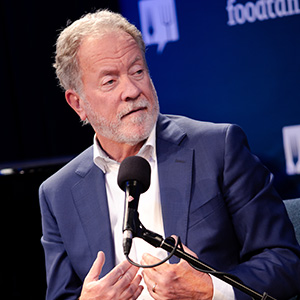
“You get data, and if you don’t use it strategically, what good is it? … If we can pre-position food and resources, it will save not just lives but hundreds of millions of dollars.”
“The situation now, and this is kind of heartbreaking, we’ve got enough data but the data is not being synthesized by the leaders at the right level to make the right decisions.”
Ruth Hill, Director, Markets, Trade, and Institutions, International Food Policy Research Institute:
“The idea with anticipatory action is you use a trigger that is a good prediction of when a crisis is going to hit, and you provide financing to those households in advance of the crisis. You say, ‘Okay, here’s some money. It’s not as big as we would come with support after the crisis, but it’s… enough money for you to buy food before the crisis hits and you can’t access markets anymore. It’s enough money to move your cattle out of the flood zone. It’s enough money to replant seeds if the rains haven’t come.’ As a result you’re able to give households the agency and the resources that they need to manage a crisis in a really much more dignified way, and actually reduce the impact of that crisis on their welfare.”
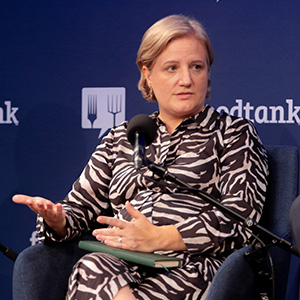
Andrew Zolli, Chief Impact Officer, Planet, the largest constellation of Earth-observing satellite systems:
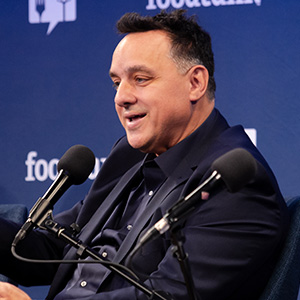
“We want to have resources ready so we don’t have a food shock. You know, the cheapest disaster to respond to is the one that you’re most prepared for.”
“We have an unbelievable set of tools. What we don’t have are institutions that are necessarily structured in exactly the right way to take advantage of those tools to address those challenges.”
“This is not a hopeless situation. This is an urgent situation. … We need bigger bets for a more complicated risk landscape, particularly as it relates to food and national security and where they intersect.”
Ertharin Cousin, Founder and CEO, Food Systems for the Future; former Executive Director of the United Nations World Food Programme:
“The working class population is feeling it. As prices tick up and remain high, that is affecting not just the vulnerable population, which has the benefits of safety nets like SNAP benefits or food banks. The working class population doesn’t have those benefits.”
“We have more data, and that allows us to predict crises better. But it doesn’t give us the capacity to act. What gives us the capacity to act, and the institutions the capacity to act, are permissions from governance and finance. And that speed has not changed with data.”
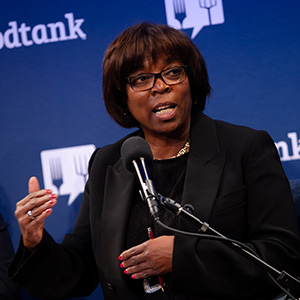
Maximo Torero Cullen, Chief Economist, Food and Agriculture Organization of the United Nations (FAO):
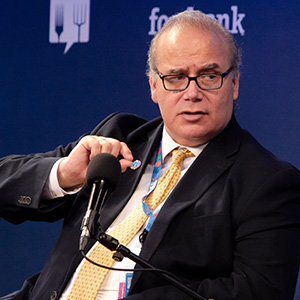
“The agricultural system has shown to be super resilient. I don’t know how much more resilient it can be. … We need to find ways in which countries can operate faster, and we need to move ways in which investment should be very precise.”
You can watch the entire event below or listen to it in podcast form on Food Talk with Dani Nierenberg (by Food Tank) wherever you get your podcasts.